Imagine walking into a company that is bleeding $1 billion a year. It has 90 days of cash left in the bank. The press is writing its obituary, calling it "beleaguered" and "doomed." This was Apple in 1997. It wasn't the shiny, trillion-dollar titan we know today. It was a bloated, confused mess.
When Steve Jobs returned to the company he founded, after being fired twelve years earlier, everyone expected him to do something "big." They expected a new, magical product line. They expected him to hire thousands of new engineers. They expected him to *add* something to save the ship.
He did the exact opposite.
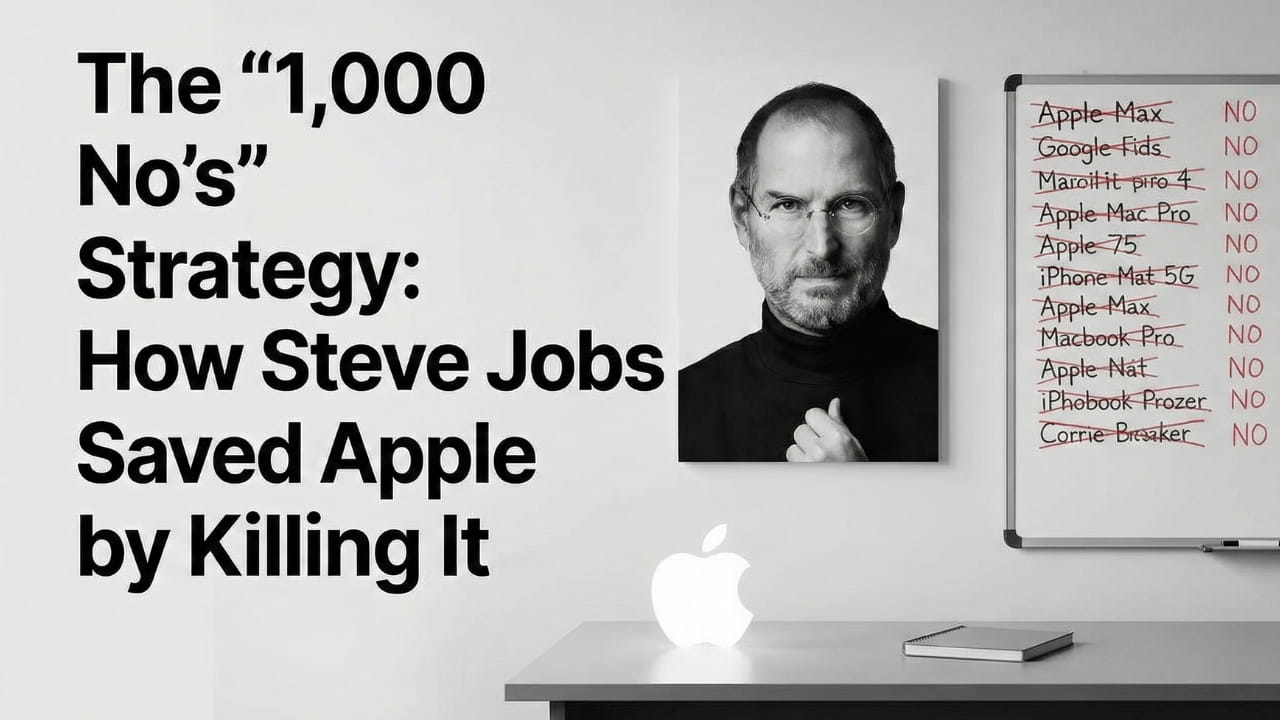
He walked into a boardroom full of tired, anxious executives, looked at the product roadmap, and slashed it to pieces. He didn't save Apple by saying "Yes." He saved it by saying "No" a thousand times.
The Trap of "Good Enough"
When Jobs arrived, Apple was trying to be everything to everyone. They had twelve different versions of the Macintosh computer. Each one had a weird code name like "Performa," "Quadra," or "PowerBook 5300." They were selling printers, scanners, servers, and even a clunky handheld device called the Newton.
Jobs spent his first few weeks just interviewing teams. He would stop engineers in the hallway. "What are you working on?" he would ask.
"We are building a new server for the enterprise market," an engineer might say.
"Why?" Jobs would ask. "Is it the best in the world?"
The answer was usually a stuttering silence.
Apple had fallen into the trap that kills most businesses—and most careers: The Trap of Good Ideas. It is easy to say no to a bad idea. Anyone can do that. But it is agonizingly difficult to say no to a "good" idea. Apple had hundreds of "good" products, but because they were doing so many, none of them were *great*. They were spreading their talent like thin butter over too much toast.
The Whiteboard Moment
One afternoon, fed up with the confusing PowerPoint presentations and the endless excuses, Jobs walked to a whiteboard in a strategy meeting. He grabbed a black marker.
"Stop!" he shouted. "This is crazy."
He drew a simple box. He drew one vertical line and one horizontal line, creating a grid with four squares.
Above the two columns, he wrote: "Consumer" and "Pro".
Beside the two rows, he wrote: "Desktop" and "Portable".
He turned to the room full of shocked executives. "This is it," he said. "We are going to make four products. One for each square. If a product doesn't fit in one of these squares, we kill it."
The room erupted in panic. "But what about the printers?" someone asked. "What about the servers? We have teams working on those! We have inventory!"
Jobs was ruthless. "We are cancelling them."
In that single meeting, he killed 70% of Apple's product line. He fired thousands of people. He enraged engineers who had spent years working on projects that were now in the trash. It was painful. It was brutal. It was controversial.
But it worked.
By focusing the entire company's genius on just four products (the iMac, the PowerMac, the iBook, and the PowerBook), they made those four products insanely great. They turned the ship around. And that laser focus created the foundation for the iPod, and eventually, the iPhone.
What Focus Actually Means
We often misunderstand the word "focus." We think focus means concentrating really hard on the thing you are doing. But Jobs taught that this is only half the truth.
He famously told his design chief, Jony Ive: "Focus means saying no to the hundred other good ideas that there are. You have to pick carefully. I'm actually as proud of the things we haven't done as the things I have done."
Innovation is saying no to 1,000 things. It is about clearing the clutter so the masterpiece can emerge.
Applying the "Kill List" to Your Life
You probably aren't running a trillion-dollar tech company, but you are the CEO of your own life. And if you are honest, your life probably looks a lot like Apple in 1997.
You are trying to learn Spanish, start a blog, get a six-pack, get a promotion, renovate your kitchen, and maintain a social life all at the same time. You are spreading your energy too thin. You are doing a lot of "good" things, but no "great" things. You are busy, but you aren't moving.
Here is how to apply the Jobs Blueprint to your own life:
1. Draw Your Grid
Take a piece of paper right now. Draw a simple box. What are the 2 or 3 things that actually move the needle in your life right now? Maybe it's "Family" and "Career." Write them down. Everything else—that side hustle you haven't touched in a month, that book club you hate, that third streaming subscription—needs to go.
2. The "Hell Yeah" Rule
When someone asks you to do something, or when you have a new idea, pause. Ask yourself: "Is this a HELL YEAH?"
If the answer is "maybe" or "it sounds kind of cool" or "I guess I should," then the answer should be a hard NO. "Good" is the enemy of "Great." Fill your life only with "Hell Yeahs."
3. Murder Your Darlings
This is the hardest part. You have to kill projects you like. Jobs liked the Newton. He liked some of the printers. But they were distractions.
Look at your calendar. Cancel the coffee meeting with the person you don't really like. Unsubscribe from the newsletters you don't read. Delete the apps that don't serve you. Be ruthless with your time so you can be generous with your energy on the things that matter.
The Final Takeaway
- Success is Subtraction: You don't get more results by adding more tasks. You get more results by removing the noise so the signal can come through.
- Pain is Necessary: Saying "no" hurts. You will disappoint people. You will feel FOMO (Fear Of Missing Out). That pain is the price of excellence.
- One Great Thing > Ten Good Things: The world rewards mastery, not mediocrity. It is better to do one thing at an elite level than ten things at an average level.
Look at your to-do list today. Don't ask "What can I add?" Ask "What can I kill?"