In 2001, Elon Musk was not yet the Iron Man figure of Silicon Valley. He was just a wealthy dot-com guy with a crazy idea. He wanted to buy a rocket, put a small greenhouse on it, send it to Mars, and take a photo of a green plant against the red soil. He thought this image would reignite the world's passion for space exploration.
He flew to Moscow to buy a refurbished ICBM (Intercontinental Ballistic Missile). He sat in a smoky room with Russian aerospace executives and asked, "How much for a rocket?"
They looked at him, laughed, and said, "Eight million dollars." For *one* rocket.
Musk did the math. With his budget, he could maybe afford one launch. Maybe two. And in the rocket business, things blow up. If the first one failed, his money would be gone, and the dream would die. The Russians thought he was a tourist. They practically spat on him as he left the meeting empty-handed.
On the flight back home, Musk stared out the window. Most people in his position would have given up. They would have said, "Well, rockets are expensive. That's just a fact. Only governments like NASA or Russia can build them. I guess I'll go do something else."
That is thinking by Analogy. It means looking at what others are doing, looking at the current "menu" of options, and assuming that is the only way reality works.
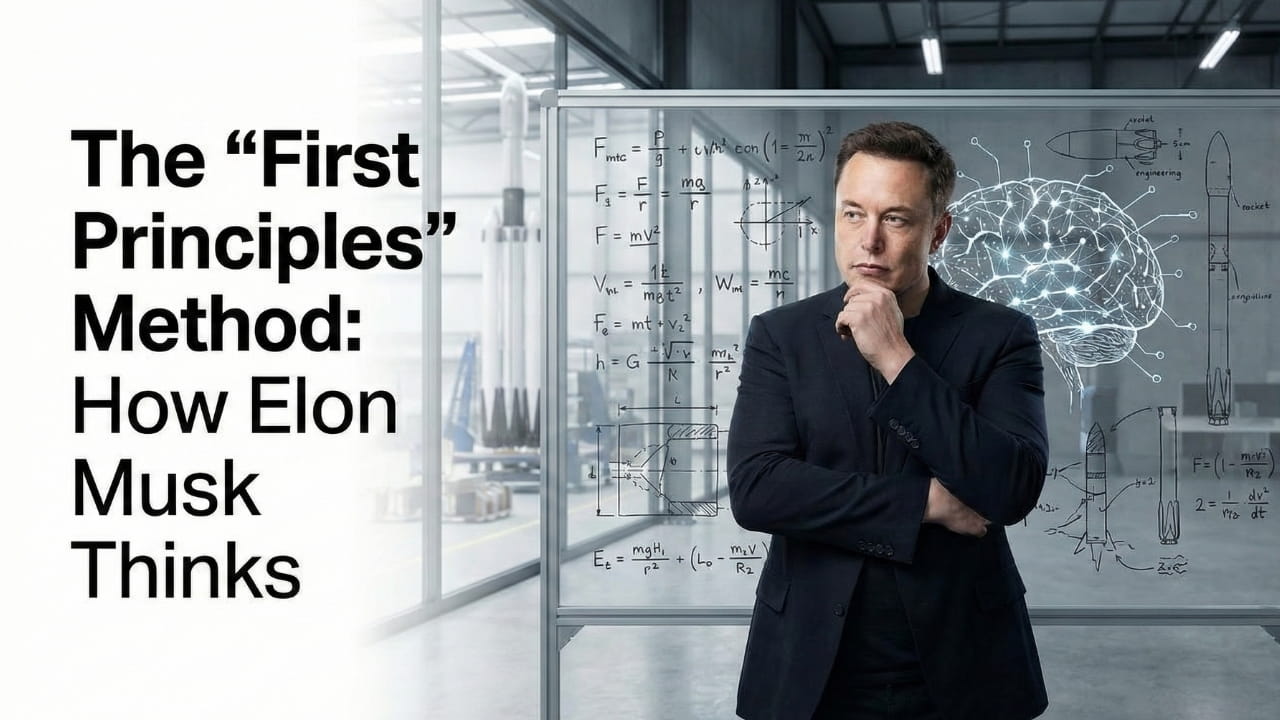
Musk chose a different path. He pulled out his laptop and opened a spreadsheet. He started doing some physics. He used a mental model called First Principles Thinking.
The Chef vs. The Cook
To really understand this, think about the difference between a Chef and a Cook.
A Cook uses a recipe. They look at what someone else has created, and they copy it. If they run out of a specific ingredient, they get stuck. They say, "I can't make this dish because I don't have paprika." They are reasoning by analogy—copying what already exists.
A Chef understands the chemistry of flavor. They know that heat + protein + salt creates a reaction. They don't need a recipe because they understand the fundamental truths of cooking. If they don't have paprika, they know exactly what else to use to get the same result. They can invent something entirely new because they understand the building blocks. They reason by First Principles.
On that plane ride from Russia, Musk decided to stop being a customer (a Cook) and become a manufacturer (a Chef).
Boiling It Down to Physics
Instead of asking "How much does a rocket cost?", Musk asked a deeper, simpler question: "What is a rocket made of?"
He broke the problem down to its fundamental atomic level. He listed the materials: aerospace-grade aluminum alloys, titanium, copper, and carbon fiber.
Then he asked a second question: "What is the market price of these raw materials on the London Metal Exchange?"
He was shocked. When he added up the cost of the raw materials needed to build a rocket, it was only about 2% of the typical price of a rocket purchase.
This was the "Eureka" moment.
If the materials only cost 2%, then the other 98% of the price wasn't "physics." It was inefficiency. It was bloated supply chains. It was government bureaucracy. It was "how it's always been done."
Musk realized that if he could figure out how to put those raw materials together himself—if he could be the Chef—he could build a rocket for a fraction of the price that NASA or the Russians charged.
He didn't need to be a billionaire to go to space; he just needed to be a better manufacturer. This realization birthed SpaceX. Today, SpaceX launches rockets for a fraction of the cost of its competitors and dominates the global space industry, all because Musk refused to accept the "menu price" of a rocket.
Applying First Principles to Your Life
You might not be building rockets, but you face "impossible" problems every day. You tell yourself stories like: "I can't afford to buy a house." "I can't start a business because I don't have investors." "I can't get in shape because I have bad genetics."
These are arguments by Analogy. You are looking at what others are doing (the Cook) and assuming their limitations are yours. Here is how to apply Musk's blueprint to break through those walls.
Step 1: Identify the Assumption
Start with the statement you believe is true, the wall hitting your face.
"Battery packs are really expensive, and that’s just the way they will always be. That's why
electric cars won't work."
Step 2: Break It Down
Ask "Why?" repeatedly until you get to the fundamental truth.
"Why are they expensive? Because they cost $600 per kilowatt-hour. Okay, but what are they made
of? Cobalt, nickel, aluminum, carbon, polymers. Stop there. If you bought those metals on the stock
exchange, how much would they cost? $80 per kilowatt-hour."
Step 3: Create a New Solution
Now that you know the fundamental truth (the materials are cheap), you can rebuild the solution from scratch. You realize the problem isn't the battery; it's the way people are putting it together. You can innovate on the method, because the physics allows it.
Real World Example: Starting a Business
- The Analogy Thinker says: "To start a business, I need to rent an office, hire staff, and buy inventory. That costs $50,000. I don't have $50,000. Therefore, I can't start."
- The First Principles Thinker says: "What is a business fundamentally? It is simply providing value to a customer in exchange for money. Do I need an office for that? No, I have a laptop. Do I need staff? No, I have my brain. Do I need inventory? Not if I sell a service or a digital product. The cost of 'providing value' is actually $0. I can start today."
The Final Takeaway
First Principles thinking is hard. It requires mental energy. It is much easier to just copy what your neighbor is doing. But copying only gets you average results.
If you want to do something new—something innovative, cheaper, or faster—you have to ignore the "market price" and look at the "material cost." You have to ignore the recipe and look at the ingredients.
Don't let "how it's always been done" stop you from doing it better. The rules of society are made up. The rules of physics are real. Follow the physics.