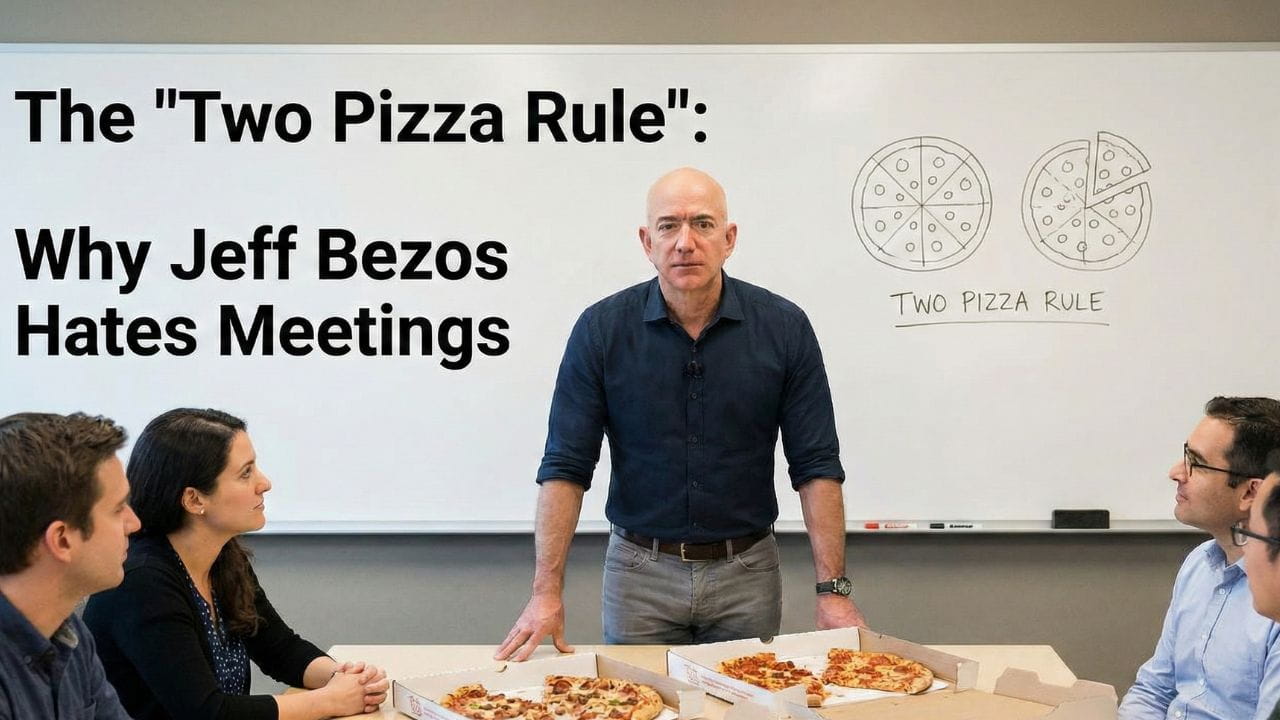
We have all been trapped in the "Meeting from Hell." You are sitting in a conference room (or zoning out on a Zoom call). There are 18 people on the screen. One person is talking. Four people are secretly checking their email. Three people are nodding but thinking about what they want for lunch. And everyone else is wondering the same thing: "Why am I here?"
This is the silent killer of modern productivity. It’s the "Big Meeting."
In the early 2000s, as Amazon began to explode from an online bookstore into a global giant, Jeff Bezos noticed something terrifying. As his company got bigger, it was getting slower. Decisions that used to take five minutes were now taking five days. Innovations were getting strangled by committees.
Bezos was obsessed with avoiding "Day 2." In his philosophy, "Day 1" is the startup phase—full of vitality, speed, and risk. "Day 2" is stasis. Followed by irrelevance. Followed by death. And the hallmark of Day 2 is bureaucracy.
To fight this, Bezos implemented a rule that became legendary in Silicon Valley. It wasn't a complex corporate policy written by HR. It was a simple, physical constraint based on lunch.
He called it the "Two Pizza Rule."
The Rule: Deceptively Simple
The rule is exactly what it sounds like: No internal meeting or team should be larger than what two pizzas can feed.
If you order two large pizzas for the group and people go hungry, the group is too big. Send some people home. Split the team in two. Cancel the meeting. Do whatever you have to do, but do not let that room get crowded.
Depending on the appetite of your engineers, this usually limits a team to a maximum of 6 to 8 people.
At first glance, this sounds like a cost-saving measure or a quirk of a hungry CEO. But it has nothing to do with food costs. It has everything to do with the mathematics of human communication.
The Insight: Communication is a Bug
Most companies preach "more communication." They want everyone to be "in the loop." Bezos preached the opposite. He famously said, "Communication is terrible!"
He meant that the necessity for frequent communication between large groups is a sign of poor organization. Why? Because of the Math of Chaos.
Let’s break it down:
- If you have a team of 3 people, there are 3 connection lines between them. A talks to B, B talks to C, A talks to C. Easy.
- If you double the team to 6 people, the connection lines jump to 15.
- If you double it again to 12 people, the connections explode to 66.
Every time you add one person to a meeting, you don't just add one brain; you add multiple new lines of communication that have to be maintained. Everyone needs to be updated. Everyone needs to "sync up." Everyone needs to "circle back."
In big teams, people spend more time talking about the work than actually doing the work. By capping the team size at "Two Pizzas," Bezos capped the communication links. He forced efficiency by design.
The Result: An Invention Machine
This rule created a unique structure at Amazon. Instead of a giant, slow-moving monolith, Amazon became a collection of hundreds of tiny, autonomous startup teams.
Each "Two Pizza Team" acts like a Navy SEAL unit. They have a specific mission (e.g., "Make the checkout button faster" or "Build a better search bar"). They have the authority to make decisions without asking for permission from a VP. They own their failures, and they own their wins.
This is how Amazon invented AWS (Amazon Web Services).
AWS wasn't a top-down mandate from a boardroom committee. It started because small engineering teams realized they needed better tools to build their own projects. They built it for themselves first—fast, messy, and functional. Then they realized the world needed it too. If that project had been run by a committee of 50 people, they would still be arguing about the color of the logo.
Applying the Pizza Rule to Your Life
You don't need to be a tech billionaire to use this blueprint. You can apply the Two Pizza Rule to your career, your side hustle, and even your social life to regain your sanity.
1. The "Dinner Party" Standard
Have you ever been to a dinner party with 12 people? What happens? The conversation fragments. It splits into three different boring chats about the weather. You end up only talking to the person right next to you. It’s loud, chaotic, and shallow.
Now think of a dinner with 6 people. Everyone sits at one table. Everyone participates in one single, deep conversation. You actually connect. If you are planning a brainstorming session, a family gathering, or a project launch, keep the invite list tight. Depth requires intimacy.
2. The "Reply All" Trap
Check your email inbox. Look for a thread where 10 people are CC'd. Is anyone taking action? Probably not.
This is called the "Bystander Effect." When everyone is responsible, no one is responsible. Everyone assumes "someone else" will handle it. Be the hero who trims the list. Move people to BCC. Say, "I'm removing John and Sarah to save their inboxes." You aren't being rude; you are being efficient.
3. Solopreneur Focus
If you are working alone, you might think this doesn't apply to you. But it does. You just need to swap "people" for "priorities."
Imagine your mental energy is the pizza. Can you "feed" 10 different priorities (projects, hobbies, side hustles) with your limited energy? No. You will starve them all. None of them will grow.
Pick two main goals. Feed them well. Let the others starve. It is better to have two well-fed, successful projects than ten malnourished ideas that never launch.
The Final Takeaway
We often think that including more people is "inclusive" or "nice." But in business and creative work, exclusion is a virtue.
- Speed over Consensus: Small teams can make a decision and act on it before a large team has even scheduled the meeting.
- Ownership over Hiding: In a team of 5, there is nowhere to hide. You have to contribute. In a team of 50, you can coast for years.
- Clarity over Noise: Fewer voices mean less noise. Less noise means a clearer signal.
Next time you send a calendar invite, imagine buying lunch for everyone in the room. If you can't afford the pizza, cut the guest list.