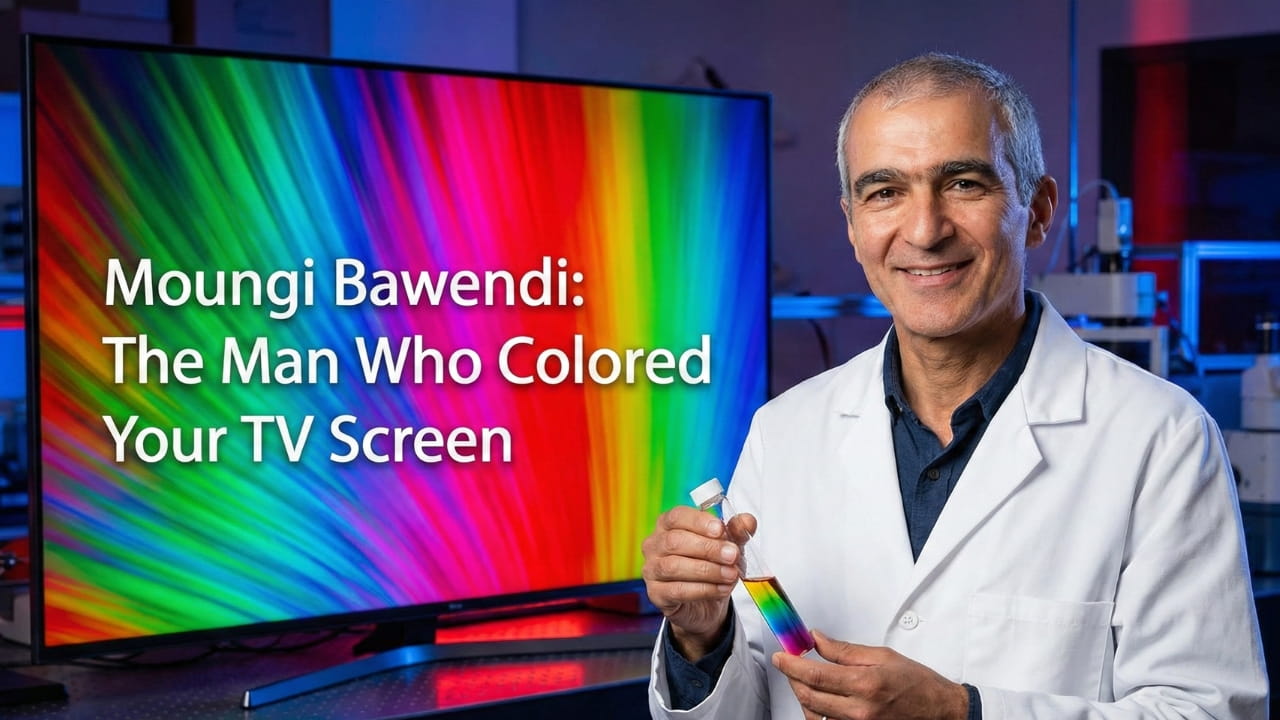
Next time you sit down to watch a movie on a modern 4K TV, take a moment to look at the colors. Notice how the green of the jungle looks impossibly deep, or how the red of a sports car seems to pop off the screen. That brilliance isn't magic. It is nanotechnology. And it exists because of a man who, decades ago, sat in a Harvard exam hall staring at a blank piece of paper, convinced he was a failure.
His name is Moungi Bawendi. In 2023, he stood on a stage in Stockholm to accept the Nobel Prize in Chemistry for his work on Quantum Dots.
But his path to that stage wasn't a straight line of straight A's. It was a winding road of doubt, hard work, and a relentless curiosity to control the smallest things in the universe. This is the story of how a "bad student" changed the way we see the world.
A Childhood in Motion
Moungi Bawendi was born in Paris, France, in 1961, but he didn't stay there long. He was the son of Mohammed Salah Baouendi, a brilliant Tunisian mathematician. His father’s career meant the family was always moving—from France to Tunisia, and eventually to the United States, settling in West Lafayette, Indiana.
Growing up in the house of a mathematician meant that science wasn't just a subject at school; it was the language of the dinner table. Moungi was bright. He was curious. He excelled in high school science classes. He entered Harvard University in the late 1970s with his head held high, expecting to breeze through just like he always had.
He was wrong.
The Exam That Crushed His Ego
It was his first year at Harvard. He walked into his first chemistry exam feeling prepared. He sat down, flipped the paper over, and froze.
The first question looked like a foreign language. "I stared at it," he recalled years later, "and I couldn't figure it out." He moved to the second question. Nothing. The third. Panic began to set in. The silence of the exam hall was deafening, broken only by the scratching of other students' pens—students who seemed to know exactly what they were doing.
When he got his grade back, it was a 20 out of 100. It was the lowest score in the entire class.
"I thought, 'Oh my god, this is the end of me, what am I doing here?'" he said. For a young man whose identity was built on being "the smart kid," this was an existential crisis. He seriously considered dropping out of science. He thought he wasn't cut out for it.
But then, something shifted. Instead of letting the failure define him, he decided to analyze it. He realized he hadn't been studying to understand; he had been studying to memorize. He changed his entire approach. He started solving problems from first principles. He didn't just want to know the answer; he wanted to know the "why."
He never failed an exam again.
The Problem of the "Mush"
By the early 1990s, Bawendi had earned his PhD and was working at Bell Labs, a legendary research facility. At the time, physicists were excited about a theoretical particle called a Quantum Dot.
These are tiny crystals of semiconductor material, only a few nanometers wide. To grasp the scale, if a quantum dot were the size of a soccer ball, the soccer ball would be the size of the Earth.
Theory suggested that if you could make these dots, they would have a bizarre property: their color would depend entirely on their size. A big dot would glow red. A medium dot would glow green. A tiny dot would glow blue.
It sounded amazing, but there was a catch. Nobody could make them properly. The existing methods produced low-quality, uneven crystals. Scientists called it "mush." You couldn't use "mush" to build technology.
Bawendi joined MIT as a professor in 1990, and he made it his mission to solve this problem. He needed to find a way to make perfect crystals, every single time.
The "Hot Injection" Breakthrough
In 1993, after years of experimentation, Bawendi and his team had a "Eureka" moment. They developed a technique that was surprisingly similar to cooking.
It was called the "Hot Injection" method.
Imagine boiling a pot of oil on a stove. Bawendi discovered that if he injected the chemical ingredients into the hot solvent instantly—like splashing water into a hot pan—the crystals would form immediately. This "shock" created billions of tiny seeds at once.
Then, by carefully lowering the temperature, he could stop the process. If he let them grow for a few seconds longer, they became red dots. A few seconds less? Blue dots.
For the first time in history, a human being could tune color with absolute precision. He held up vials of glowing liquid in the lab—neon pinks, electric blues, vibrant greens. They were perfect.
He hadn't just discovered a particle; he had invented the recipe to mass-produce them.
From the Lab to Your Living Room
Usually, scientific discoveries stay in the lab for fifty years. Bawendi’s dots escaped almost immediately.
Tech giants like Samsung and Sony realized that these dots solved a massive problem with TVs. Traditional screens used white LED lights filtered through colored glass, which made colors look muddy. But Quantum Dots emitted pure, perfect light.
This technology became QLED (Quantum Light-Emitting Diode). If you have bought a high-end TV in the last five years, there is a very good chance it contains a film of Moungi Bawendi’s nanoparticles.
But the applications went beyond entertainment.
Doctors realized that because these dots glowed so brightly, they could be attached to biological cells. Surgeons began using them to "light up" tumor tissues during cancer surgery. The dots would stick to the cancer cells and glow under a special light, showing the doctor exactly where to cut, saving healthy tissue and lives.
The Nobel Call
In October 2023, decades after his breakthrough, Moungi Bawendi was asleep in his home in Massachusetts. His phone rang. It was Sweden.
He had won the Nobel Prize in Chemistry.
He was humble about it. He didn't claim to be a genius. In his press conferences, he talked about his students. He talked about the teamwork. And, most importantly, he talked about that 20/100 exam score.
He uses his story to comfort his own students at MIT today. When they struggle, when they fail a test, when they feel like imposters, he tells them: "You are not your grades. Failure is just data. Use it."
Lessons from a Nobel Laureate
- Failure is Not Final: Bawendi failed spectacularly at the very subject he won a Nobel Prize in. The difference between a failure and a success is often just time and persistence.
- Process is Everything: He didn't just discover the "what" (Quantum Dots); he figured out the "how" (Hot Injection). Great ideas are worthless if you can't replicate them.
- Science is for Everyone: His work sits in our living rooms and helps heal our bodies. The best science doesn't stay in the ivory tower; it improves the quality of daily life for everyone.
So the next time you marvel at the colors on your screen, remember the student who got an 'F' and decided to try again.