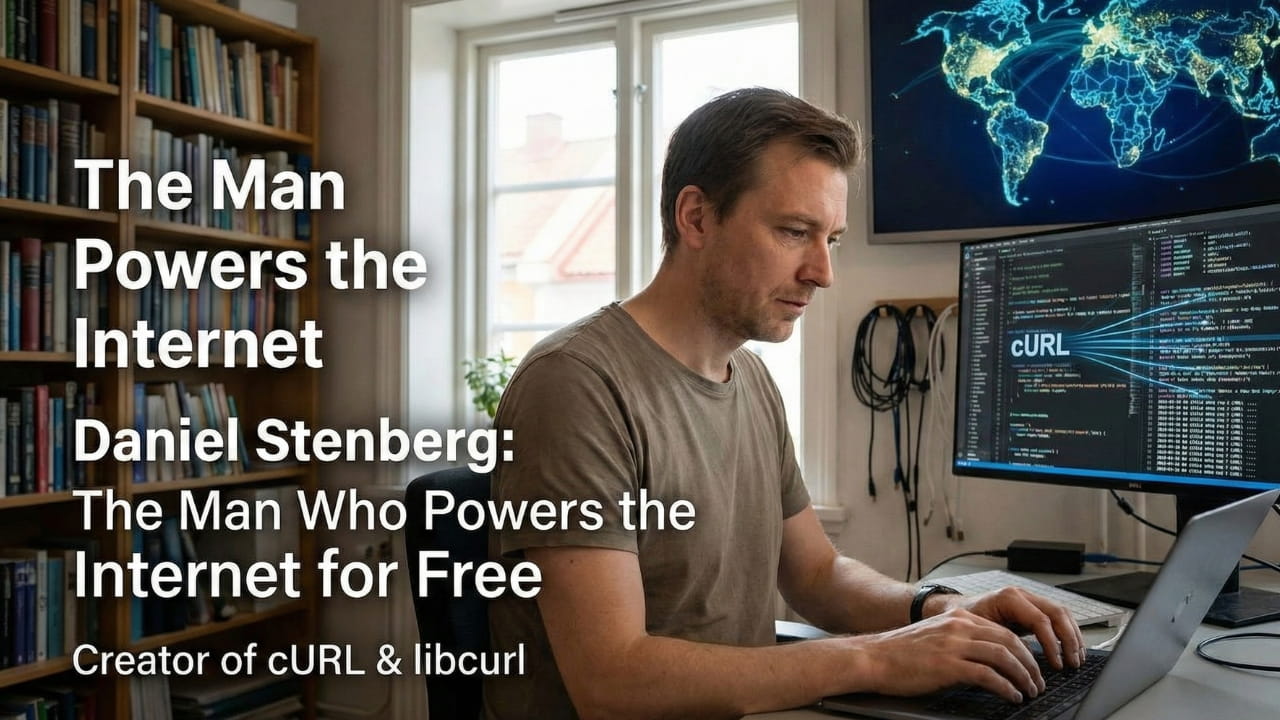
If you have checked Instagram today, streamed a movie on Netflix, ordered an Uber, or even just started your car, you have used Daniel Stenberg's work. He is arguably one of the most influential people in the digital world, yet if he walked past you in a grocery store, you wouldn't blink.
He didn't found a startup in a Silicon Valley garage. He didn't ring the opening bell on Wall Street. He didn't become a billionaire. Instead, he wrote a small piece of code in the 1990s as a hobby, and for the last 25 years, he has given it away to the world for free.
This is the incredible true story of cURL, the silent engine that powers the modern internet, and the humble Swedish programmer who keeps it running from his home office.
The Hacker in the Bedroom
Daniel Stenberg’s journey didn't begin with venture capital or a grand vision of world domination. It started in Huddinge, Sweden, in the 1980s. Like many legends of the computer age, his life changed the day he got his hands on a Commodore 64.
It was a simple machine with a blocky screen and limited memory, but to Daniel, it was a portal to a new dimension. He wasn't satisfied with just playing games; he wanted to know how they worked. He taught himself Assembly—the raw, difficult language that speaks directly to the computer's hardware. While other kids were outside playing soccer, Daniel was inside, staring at green text on a black screen, learning to control the machine.
This obsession with the "nuts and bolts" of technology—the plumbing that makes everything else work—would define his entire career. He didn't just want to drive the car; he wanted to build the engine.
The Simple Problem: "How Much is a Dollar?"
The invention that would eventually run on billions of devices didn't come from a desire to change the world. It came from a trivial annoyance.
In late 1996, the internet was young. Daniel was hanging out in IRC (Internet Relay Chat) rooms, discussing code with strangers. He decided to write a "bot"—a simple script that would automate tasks in the chat room. He had a specific idea: he wanted his bot to tell users the current currency exchange rates.
To do this, the bot needed to visit a website, download the exchange rate data, and display it in the chat. It sounded simple. But back then, there wasn't an easy command-line tool to just "grab" a webpage.
So, Daniel did what any hacker would do: he wrote one.
He created a tiny tool called httpget. It did exactly one thing: it got data from a website using the HTTP protocol. It was crude. It was simple. And it worked.
But then, he wanted to download currency rates from a different site that used a different protocol (FTP). So he added that capability. Then he added support for Gopher (an old internet protocol). Then he added the ability to upload files, not just download them.
The tool grew. In 1998, he renamed it cURL (Client URL). He released it to the world as "Open Source," meaning anyone could use it, copy it, or modify it for free.
The Code That Ate the World
Daniel thought a few hundred people might use it. Maybe some other hobbyists in Sweden. He was wrong.
As the internet exploded in the 2000s, developers everywhere faced a problem: they needed their programs to talk to the internet. They didn't want to write complex networking code from scratch every time they built an app. They realized they didn't have to. They could just use Daniel's tool.
It started small. Then, things got crazy.
Apple added cURL to macOS. Google added it to Android. Car manufacturers added it to their GPS systems. Television makers added it to smart TVs.
Today, cURL is estimated to be installed on over 10 billion devices worldwide. It is the most used software component in history.
When you open Spotify, cURL is likely helping stream the music. When you play *Grand Theft Auto*, cURL handles the online connection. When you check your smart fridge, cURL fetches the weather. Even the Nintendo Switch uses it.
But the most incredible moment came from outer space. When NASA landed the Ingenuity Helicopter on Mars, Daniel checked the code logs. There it was. His code—written in a bedroom in Sweden—was currently running on the surface of another planet.
The Wealth of Giving
Here is the part that confuses most business people. Daniel Stenberg gave this away.
He didn't charge a licensing fee. If he had charged even $0.001 per device, he would be a billionaire several times over. Instead, for decades, he worked a normal day job to pay his bills. He would come home, eat dinner with his family, and then spend his nights and weekends fixing bugs in cURL for free.
Why?
"It's about the fun of coding," Daniel has said in interviews. "It's about solving problems and helping people. If I charged for it, it wouldn't be everywhere. It wouldn't be on Mars."
He represents the purest form of the internet's original promise: collaboration. He is a "maintainer"—one of the invisible janitors of the web who ensure that the digital world doesn't collapse, often without thanks or pay.
In recent years, his contribution has finally been recognized. He received the Polhem Prize from the King of Sweden. Companies have started to step up, and he is now employed by WolfSSL to work on cURL full-time, finally getting paid to do what he loves.
Yet, he remains humble. He still sits at his computer, merging code updates, responding to bug reports from angry users who have no idea they are talking to a legend, and making the internet a little bit more stable for the rest of us.
Lessons from Daniel Stenberg
- Solve Your Own Problem: cURL didn't start as a grand vision to dominate the world. It started because Daniel wanted currency rates in a chat room. Don't worry about saving the world; just solve the small problem in front of you. You never know where it leads.
- Consistency Beats Intensity: Daniel has been working on cURL almost every day for nearly 30 years. He didn't burn out; he paced himself. True legacy is built on decades of showing up, not one week of grinding.
- Value Isn't Always Money: Daniel isn't on the Forbes list, but his impact is greater than most who are. There is a profound satisfaction in knowing you have built something useful, something that will outlast you, even if it doesn't make you rich.
The next time your phone connects to the internet, remember the man in Sweden who built the bridge for you.