There is a strange phenomenon in life: the moment you decide to improve yourself, the people around you often stop cheering. You start a business, and they ask why you're risking your savings. You start going to the gym, and they ask why you've become "obsessed." You try to quit a bad habit, and they tease you for being boring. This isn't just bad luck. It's a psychological trap known as the Crab Bucket, and Leo was right in the middle of it.
Leo was a good man, hardworking and smart. He lived in a small, foggy coastal town where people were born, fished the same waters as their fathers, drank at the same tavern every Friday, and eventually died without ever seeing much of the world. But Leo had a fire in his belly. He stayed up late reading about digital marketing, ecommerce, and travel. He wanted to build an online business. He wanted freedom.
But every time he brought up his dreams at the tavern, the mood would shift.
"Oh, look at Mr. Entrepreneur," his childhood friend Sam would sneer over a pint. "You think you're better than us now, Leo? You think this town isn't good enough for you?"
"It's not that," Leo would stammer, feeling the heat rise in his cheeks. "I just want to try something new."
"You'll fail," another friend would chime in. "Stick to what you know. It's safer."
Leo felt heavy. It felt like walking through mud. Why did his ambition feel like a betrayal to them? Needing to clear his head, he woke up early one Saturday morning and walked down to the old wooden pier. The air smelled of salt and seaweed. At the end of the dock sat an old fisherman named Elias, smoking a pipe next to a large, rusted metal bucket.
The Bucket Without a Lid
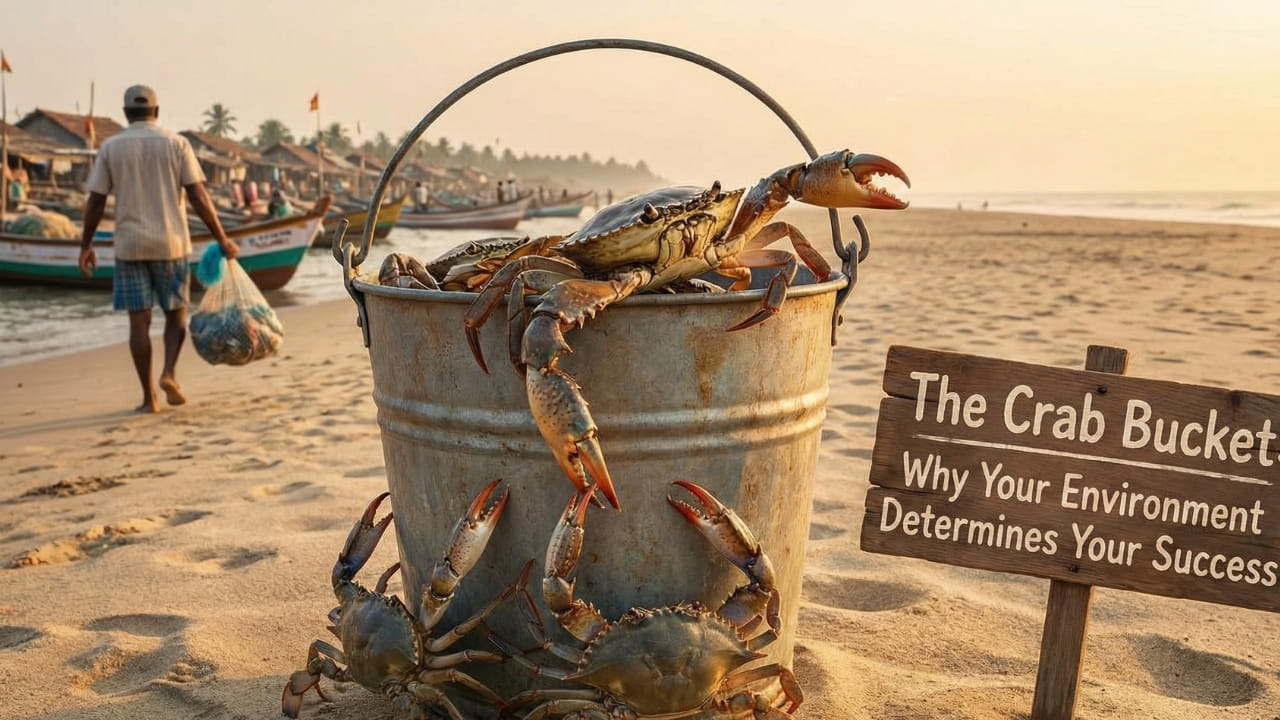
Leo leaned against the railing and looked down. The bucket was teeming with live crabs that Elias had just caught. They were a chaotic mess of clicking claws and scraping shells, climbing over one another in the dark, cramped space.
But something caught Leo's eye. The bucket had no lid.
He frowned. The water level inside was low, but the pile of crabs was high. Any single crab could easily reach a leg over the rim and pull itself out. In fact, they looked strong enough to escape in seconds.
"Excuse me," Leo said, gesturing to the bucket. "Sir, you might want to cover that up. Your catch is going to run away."
Elias didn't even look up from baiting his hook. He just chuckled—a dry, raspy sound like sandpaper. "No they won't, son. Just watch."
Leo stepped closer, skeptical. He focused his eyes on one particularly large, feisty crab near the top of the pile. It was determined. It scrambled over the backs of its brothers, reached up with a powerful claw, and hooked the metal rim of the bucket. It began to pull. Its body lifted out of the mass. It was halfway to freedom.
"See!" Leo pointed. "That one is leaving!"
"Keep watching," Elias said softly.
The Pull of the Crowd
Just as the escaping crab hoisted itself up, the mass of crabs below it surged. They didn't ignore it. They didn't push it up. They reached up with their pincers. They grabbed the escaping crab's back legs. They clamped onto its shell.
With a violent jerk, they dragged it back down.
The escaping crab lost its grip and tumbled back into the dark pile, buried once again under the weight of the others.
A minute later, another crab tried on the opposite side. It fought its way to the top, reached for the light, and grasped the edge. Freedom was inches away. But again, the moment it separated itself from the group, the others reached up. They grabbed it. They pulled. They dragged it back into the misery.
Leo stared in horror. "Why do they do that?" he whispered. "If they just helped each other, they could all form a ladder and escape. Why are they fighting the one who is succeeding?"
Elias finally looked up, his eyes sharp and knowing under his brimmed hat. "Because, son, that is the nature of the crab. If one tries to climb up to a higher place, the others feel threatened. They will pull it down. If it persists, they will even break its claws to keep it in the bucket with them. They would rather all die together in the dark than let one of them succeed alone in the light."
Seeing the Human Crabs
Leo walked away from the pier that morning, but the image of the bucket was burned into his mind. He didn't see crustaceans anymore. He saw his Friday nights at the tavern.
He realized why his friends mocked his new ideas. He realized why his family told him to "be realistic" and "play it safe." He realized why his coworkers rolled their eyes when he stayed late to learn a new skill.
They weren't bad people. They didn't hate him. They were just scared.
When Leo tried to climb out of the bucket of their shared reality—their small town, their small paychecks, their small complaints—it reflected their own stagnation back at them. His success threatened their comfort. If he escaped, it meant escape was possible, and they had simply chosen not to try. That is a painful truth to face. So, subconsciously, they reached up to pull him back down to their level, where it was safe, crowded, and comfortable.
The Moral: You Must Change Buckets
The lesson of the crab bucket is harsh but necessary: You cannot change the crabs. You can explain to them until you are blue in the face why they should let you go, but their nature is to pull.
If you are currently surrounded by people who mock your ambition, question your dreams, or comfort you with mediocrity, you are in a crab bucket. No matter how strong you are, the collective weight of their negativity will eventually drag you down.
The solution is simple, though it is not easy:
- Audit Your Circle: Look at the 5 people you spend the most time with. When you share a win, do they light up, or do they dim your shine? When you share a dream, do they offer a ladder, or a claw?
- Find the Climbers: You need to find a new bucket. You need to find a circle of people who are also trying to get out. In these circles, when someone climbs, the others don't pull them down—they push them up, knowing that if one escapes, they can drop a rope for the rest.
- Love From a Distance: You don't have to hate the crabs. You can love them. But you cannot let them hold your legs while you are trying to run. Sometimes, you have to love people from a distance to save yourself.
You are not stuck because you are weak. You are stuck because you are carrying the weight of everyone who is afraid to see you fly. Let go. Climb. And don't look back.